

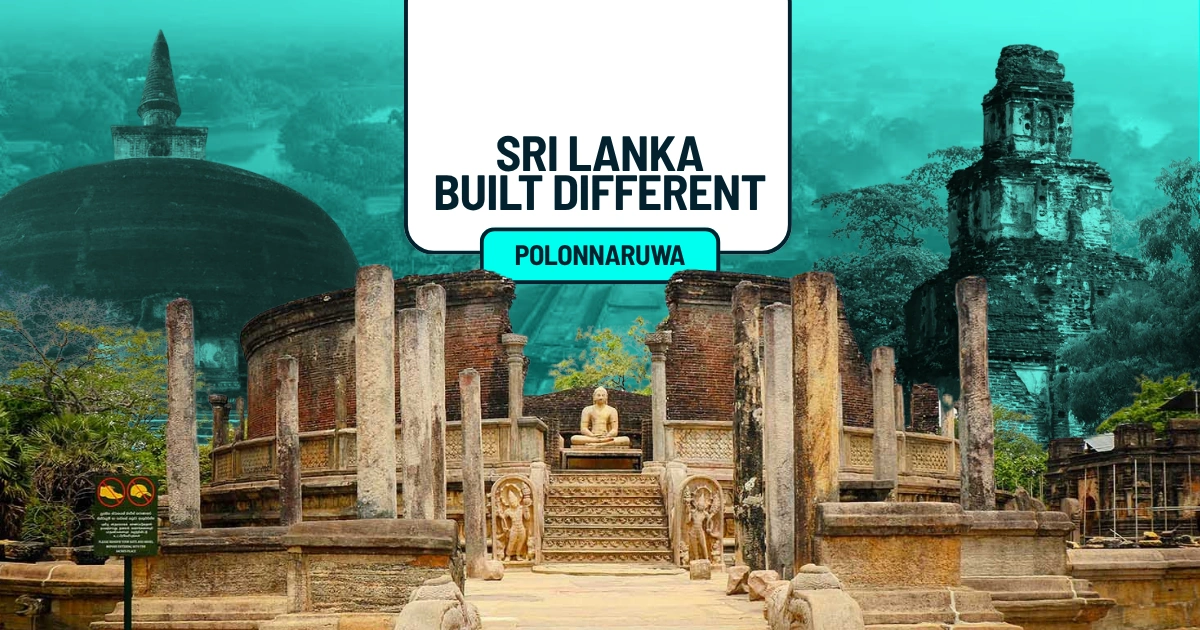
Imagine walking through the ancient city of Polonnaruwa.
Around you are enormous stone sculptures, ancient temples, ruined palaces, brick structures and carefully planned spaces that have survived for centuries.
Nearby, the waters of Parakrama Samudra stretch across the landscape.
It is easy to look at Polonnaruwa simply as a collection of ancient ruins.
But look closer, and a different story begins to emerge.
Polonnaruwa was a centre of political power, religion, agriculture, architecture, medicine and regional connections. Its development depended not on a single invention, but on systems of irrigation, construction, administration, culture and trade working together.
That is what makes Polonnaruwa particularly interesting today.
Because while the technology around us has changed dramatically, some of the problems businesses face have not.
How do you build systems that support growth?
How do you manage limited resources?
How do you connect local activity with wider markets?
How do you create something valuable enough to last?
These are modern questions.
But Polonnaruwa shows that Sri Lanka has been thinking about systems, infrastructure and innovation for centuries.
This is the first article in Sri Lanka Built Different, a Garlic Collective series exploring Sri Lanka's heritage, culture, innovation, people and businesses and what they can teach us about building the future.
Why Is Polonnaruwa Important?
Polonnaruwa is important because it became Sri Lanka's second great capital during the medieval period and developed into an important centre of political power, agriculture, Buddhist and Hindu religious life, architecture, healthcare and regional connections.
The ancient city is particularly known for its sophisticated irrigation infrastructure, monumental architecture, Gal Vihara's rock-cut Buddha images, religious complexes and archaeological evidence of medieval Sri Lankan society.
UNESCO inscribed the Ancient City of Polonnaruwa as a World Heritage Site in 1982.
A Brief History of Polonnaruwa
The history of Polonnaruwa goes back much further than its period as a capital.
The Central Cultural Fund records evidence of activity at the site going back to pre-Christian times, including a 2nd-century BCE Brahmi inscription associated with a cave donated to Buddhist monks. During the Anuradhapura period, Polonnaruwa served as an important provincial centre and strategic location.
After the destruction of Anuradhapura in 993, Polonnaruwa became Sri Lanka's second capital. It developed into a major centre during the 11th–13th centuries, with its greatest period associated with rulers including Vijayabahu I, Parakramabahu I and Nissanka Malla.
According to the Central Cultural Fund, the Polonnaruwa period is regarded as a golden age of agriculture in Sri Lanka. King Vijayabahu I is credited with restoring irrigation works damaged during the conflicts at the end of the Anuradhapura era, while King Parakramabahu I was responsible for major irrigation development, including the massive Parakrama Samudra.
The city itself contained an inner citadel and a much larger outer city. The citadel included royal and administrative buildings, while the surrounding city contained religious establishments, residential and other structures, roads, walls and water features.
Polonnaruwa eventually declined as the principal capital amid invasions, political turmoil and other factors during the 13th century.
The Culture of Medieval Polonnaruwa
Polonnaruwa was not simply a political capital.
It was also an important centre of religious and cultural life.
Buddhist monasteries and shrines formed a major part of the city. The Sacred Quadrangle, Gal Vihara and Alahana Parivena are among the most significant sites associated with the Polonnaruwa period. Hindu religious establishments were also present, including several Shiva and Vishnu shrines.
This combination is an important part of understanding Polonnaruwa.
Its heritage is not represented by one building or one religious tradition.
It is represented by an entire cultural landscape.
Architecture, sculpture, painting, religion, agriculture and urban planning existed alongside one another.
Gal Vihara: The Art of Stone
Few places demonstrate the artistic achievements of Polonnaruwa as clearly as Gal Vihara.
The site contains colossal Buddha images carved directly into the granite rock.
The sculptures are among the most celebrated artistic achievements of the ancient city, while other image houses, including Lankatilaka and Tivanka, demonstrate the continued development of large-scale religious architecture and sculpture during the period.
The significance of Gal Vihara is not simply its size.
It represents the combination of:
Stone + craftsmanship + artistic knowledge + religious meaning
The result is something that has remained recognizable and meaningful centuries later.
The Architecture of Polonnaruwa
One of the interesting developments of the Polonnaruwa period was the extensive use of brick in major construction.
The Central Cultural Fund notes that while stone was widely used during the Anuradhapura era, brick became increasingly prominent during the Polonnaruwa period. This made it possible to construct many buildings in comparatively short periods. Large brick structures such as Lankatilaka, Tivanka and Thuparama demonstrate the scale of this architectural tradition.
The city also included massive brick ramparts and water moats, while its layout included gatehouses and what appears to have been a planned street system.
The architecture therefore tells us something beyond aesthetics.
Polonnaruwa was being designed as a functioning city.
The Technology Behind Polonnaruwa
When we hear the word "technology" today, we often think of smartphones, software, artificial intelligence and computers.
But technology is fundamentally about applying knowledge to solve problems.
By that broader definition, Polonnaruwa offers several fascinating examples of engineering and technical knowledge.
Irrigations and Water Management
Water was essential to agriculture and settlement in Sri Lanka's dry zone.
The Polonnaruwa period saw major investment in irrigation infrastructure.
Parakrama Samudra, or the "Sea of Parakrama", is one of the most famous examples.
UNESCO identifies the massive artificial reservoir and its relationship with the agricultural landscape as an important part of Polonnaruwa's Outstanding Universal Value.
The Central Cultural Fund similarly describes Parakrama Samudra as a major achievement of irrigation engineering and technological development during the reign of Parakramabahu I.
The lesson is not simply that the reservoir was enormous.
It is that agriculture depended on infrastructure designed to manage a critical resource.
Urban Infrastructure
Polonnaruwa was not just a collection of individual monuments.
The city included:
- A royal citadel
- Administrative buildings
- Religious complexes
- Roads
- Gatehouses
- Walls
- Moats
- Water features
- Residential and other structures
The Central Cultural Fund describes an inner citadel and an extensive outer city, with a planned arrangement of buildings and streets.
This demonstrates an important principle:
A successful city requires systems, not isolated structures.
Medicine and Medical Science
Perhaps one of the most fascinating examples comes from Alahana Parivena.
The monastic hospital located within the complex provides archaeological evidence of organized healthcare during the medieval period.
The Central Cultural Fund reports that the hospital had facilities for residents and external patients. Excavations also uncovered surgical instruments, providing evidence that operations were performed there.
A large stone trough, described as a "medicine boat", was also discovered. It was used for immersing patients in herbal solutions and preparations.
This gives us another perspective on innovation.
Innovation is not only about building larger structures.
It can also mean developing better ways to care for people.
Polonnaruwa and the Wider World
Polonnaruwa was also connected to wider regional networks.
The city's location was important partly because of its proximity to the major harbour of Trincomalee, historically referred to as Gōkanna Tittha.
The Central Cultural Fund notes that rulers showed interest in the Polonnaruwa area because of this proximity even before it became the capital. Archaeological evidence, including Chinese coins, also provides evidence of wider international connections.
This matters because Polonnaruwa should not be viewed as an isolated inland city.
Its history was connected to a wider network of movement, exchange and relationships.
Five Lessons Polonnaruwa Can Teach Us Today
The value of history is not only in remembering what happened.
It is also in understanding the thinking behind what people built.
Polonnaruwa offers several principles that remain relevant to modern businesses and organizations.
Build Infrastructure That Can Support Growth
Polonnaruwa's agricultural development depended heavily on irrigation infrastructure.
Water needed to be captured, stored and distributed.
The infrastructure supported agriculture, and agriculture supported society.
Modern businesses face a different version of the same challenge.
A small business might initially manage customers through WhatsApp messages, spreadsheets and manual processes.
That may work for a small number of customers.
But as the business grows, those systems can become bottlenecks.
The lesson from Polonnaruwa is not that an ancient reservoir was equivalent to modern cloud technology.
The lesson is simpler:
Growth needs infrastructure.
A business that wants to grow needs systems capable of supporting that growth.
Solve Real Problems With Technology
The innovations of Polonnaruwa addressed real needs.
Water needed to be managed.
Food needed to be produced.
Buildings needed to be constructed.
People needed healthcare.
Communities needed systems.
The same principle applies to modern technology.
A business does not need technology simply because something is new or fashionable.
Technology becomes valuable when it solves a meaningful problem.
That could mean:
- Helping customers find a business
- Reducing repetitive administrative work
- Improving communication
- Managing customer information
- Accepting online bookings
- Reaching new markets
- Automating routine tasks
The best technology is not necessarily the newest technology. It is the technology that creates useful change.
Local Businesses Don't Have to Think Locally
Polonnaruwa's historical connections with wider networks remind us that being located in one place does not mean being disconnected from the wider world.
Today, digital technology makes this principle much more accessible.
A hotel in Polonnaruwa can be discovered by a traveller before they arrive in Sri Lanka.
A food producer can build a brand beyond its district.
A craft business can introduce Sri Lankan products to international customers.
A tour operator can communicate with travellers while they are still planning their trip.
A local business can remain deeply connected to its community while building an audience far beyond it.
Your physical location does not have to define your digital reach.
Build for the Long Term
Some of Polonnaruwa's most important structures have survived for centuries.
That naturally raises a modern question:
Are we building temporary solutions, or are we building systems that can support the future?
A website should not simply look good on launch day.
A CRM should not simply become a database of contacts.
A social media presence should not simply exist to fill a content calendar.
Digital systems should support the way a business intends to operate and grow.
The goal is not to build everything at once.
It is to build the right foundations.
Innovation Can Strengthen Identity
Polonnaruwa's heritage developed within Sri Lanka's own cultural, religious and environmental context.
Modern businesses can learn from that too.
Digital transformation does not mean making every business look the same.
A business's:
Place + people + culture + product + story
can become one of its greatest competitive advantages.
Technology can help that identity travel further.
What Does This Mean for Businesses in Polonnaruwa Today?
The ancient city is one of the most important heritage destinations in Sri Lanka.
But beyond the archaeological site is a modern community of businesses serving residents, travellers and other businesses.
This creates an interesting question:
Which businesses in Polonnaruwa have the greatest opportunities to benefit from digital growth?
Several sectors stand out.
Tourism and Hospitality
Polonnaruwa's heritage creates natural opportunities for:
- Hotels
- Villas
- Guesthouses
- Tour operators
- Local guides
- Transport providers
- Cycling experiences
- Cultural experiences
For these businesses, digital visibility can influence whether a potential visitor discovers them before or after arriving in the area.
A hotel with a strong website, accurate Google information, quality photography, customer reviews and clear booking options can communicate with travellers long before they reach Polonnaruwa.
Search visibility is therefore not simply a marketing activity.
It can become part of the customer journey.
Agriculture and Food Businesses
Agriculture is deeply connected to Polonnaruwa's identity and history.
This creates opportunities for businesses involved in:
- Rice
- Fruits
- Vegetables
- Processed foods
- Traditional food products
- Agricultural products
- Food brands
The opportunity is not simply to sell a product.
It is to build a story around that product.
Instead of:
Product → Local customer
a business can work towards:
Product → Brand → Story → Online audience → Wider market
Digital platforms can help businesses communicate where their products come from, how they are produced and why they are different.
Traditional Products and Crafts
Heritage can also become an economic opportunity.
Traditional products, crafts and locally produced goods can reach audiences far beyond the physical location where they are made.
A local producer might begin with a physical shop.
Then build visibility through:
Google → Social media → Website → Online enquiries → E-commerce → Wider markets
The product remains local.
The story remains Sri Lankan.
But the potential audience becomes much larger.
Restaurants and Local Food
Food businesses have another important digital opportunity: being discovered at the right moment.
Imagine a traveller searching:
"Best Sri Lankan food in Polonnaruwa"
or:
"Where to eat near Polonnaruwa ancient city?"
A restaurant with accurate location information, strong reviews, useful photographs, an updated menu and active digital channels has a better opportunity to become part of that traveller's decision-making process.
Sometimes digital growth starts with something very simple:
Making it easy for the right customer to find you.
Local Experiences
Polonnaruwa has an opportunity to offer more than sightseeing.
Businesses can potentially develop experiences around:
- Heritage
- Cycling
- Local food
- Village life
- Cooking
- Agriculture
- Photography
- Wildlife
- Culture
The digital opportunity is to make these experiences discoverable before visitors arrive.
A traveller planning a Sri Lankan holiday may be looking for something unique weeks or months before reaching Polonnaruwa.
A strong digital presence can help connect that traveller with a local business.
How Can Polonnaruwa Businesses Reach Customers Beyond Sri Lanka?
Digital growth does not mean turning a traditional Sri Lankan business into a technology company.
It can begin with simple questions.
Discoverability
Can someone find the business when they search online?
Credibility
Can they see reviews, photographs, products and useful information?
Communication
Can they easily contact the business?
Conversion
Can they book, buy or make an enquiry online?
Efficiency
Can repetitive processes be simplified or automated?
Reach
Can the business communicate with customers outside Polonnaruwa and Sri Lanka?
These are practical digital questions.
And they apply to businesses across Sri Lanka.
From Ancient Systems to a Digital Sri Lanka
Polonnaruwa's story is not simply a story about ruins.
It is a story about systems.
Water management supported agriculture.
Architecture created spaces for religious, political and social life.
Healthcare facilities addressed human needs.
Roads, buildings and urban planning supported a functioning city.
Connections with wider networks linked Polonnaruwa to a broader world.
The technologies available today are completely different.
We have:
- Websites
- Search engines
- Social media
- Cloud platforms
- Customer relationship systems
- Automation
- Artificial intelligence
- E-commerce
- Digital communication
But the fundamental challenge remains familiar:
How do we build better systems that create more value?
That is a question that belongs to every era.
What Could the Next Digital Polonnaruwa Look Like?
Imagine a traveller discovering a small Polonnaruwa hotel through Google before arriving in Sri Lanka.
They explore its website, view photographs, read reviews, make a booking and receive useful information before their journey.
Imagine a traditional food producer building a recognizable Sri Lankan brand and reaching customers outside the district.
Imagine a local craft business telling its story through social media and reaching people overseas.
Imagine a local tour operator connecting with international travellers while they are still planning their Sri Lankan holiday.
Imagine small businesses using automation to spend less time handling repetitive work and more time serving customers.
None of these possibilities require Polonnaruwa to become something it is not.
They require its businesses to become more visible, accessible and connected.
And this is where digital technology can play an important role.
The Heritage Stays Local. The Opportunity Doesn't Have To.
Polonnaruwa reminds us that innovation is not something Sri Lanka discovered with the arrival of the internet.
The island has a long history of engineering, agriculture, architecture, healthcare, craftsmanship and connections with the wider world.
The tools have changed.
The world has changed.
But the need to solve problems, build strong systems and create lasting value has not.
For modern Sri Lankan SMEs, digital technology creates a new opportunity:
Take something deeply local and make it visible to a much larger audience.
A hotel can reach a traveller before they arrive.
A food producer can tell its story beyond its district.
A craft business can reach customers outside Sri Lanka.
A local experience can become part of someone's travel plans before they even land.
The heritage stays local.
The opportunity doesn't have to.
What Can We Learn From Polonnaruwa?
Perhaps the most important lesson is not about any particular reservoir, building or monument.
It is about thinking beyond individual problems.
Polonnaruwa's achievements came from systems working together.
Water supported agriculture.
Agriculture supported society.
Architecture supported religious and political life.
Healthcare supported communities.
Connections supported wider exchange.
Today, we have entirely different tools.
But we still need to build systems.
Systems that help businesses communicate.
Systems that help customers discover products.
Systems that reduce unnecessary work.
Systems that allow local businesses to reach wider markets.
Systems that can grow.
Sri Lanka's history shows that innovation is not new.
The next chapter is ours to write.
Frequently Asked Questions About Polonnaruwa
What is Polonnaruwa famous for?
Polonnaruwa is famous for its ancient city, medieval heritage, Buddhist and Hindu monuments, irrigation infrastructure, archaeological ruins and the rock-cut Buddha images of Gal Vihara. It is a UNESCO World Heritage Site.
Why is Polonnaruwa important in Sri Lankan history?
Polonnaruwa became Sri Lanka's second capital after the destruction of Anuradhapura in 993 and developed into an important political, religious, agricultural and cultural centre during the medieval period.
When did Polonnaruwa become the capital of Sri Lanka?
Polonnaruwa became the capital around the middle of the 11th century and remained a major capital for roughly two and a half centuries.
Who was King Parakramabahu I?
Parakramabahu I was one of the major rulers of the Polonnaruwa period, reigning from 1153 to 1186 CE. He is strongly associated with major irrigation and agricultural development, including Parakrama Samudra.
What is Parakrama Samudra?
Parakrama Samudra, meaning the "Sea of Parakrama", is a massive artificial reservoir associated with the reign of King Parakramabahu I. It is one of the defining examples of the irrigation engineering associated with Polonnaruwa.
What is Gal Vihara?
Gal Vihara is a famous Polonnaruwa monument containing colossal Buddha images carved into granite. It is considered one of the most significant artistic achievements of the ancient city.
What was the Alahana Parivena hospital?
Alahana Parivena included a monastic hospital complex. Archaeological excavations uncovered surgical instruments and a large stone "medicine boat" used for treatments involving herbal preparations.
What businesses have digital opportunities in Polonnaruwa?
Tourism and hospitality, restaurants, agriculture and food products, traditional crafts, local products, tour operators and cultural experiences are sectors with clear opportunities to improve online visibility and reach customers beyond Polonnaruwa.
How can Polonnaruwa businesses reach international customers?
Businesses can use websites, search visibility, Google Business Profiles, social media, online booking, e-commerce and digital communication to make their products and services easier for international customers to discover and engage with.
Sri Lanka Built Different - Episode 01
Polonnaruwa gives us more than an opportunity to look backwards.
It gives us an opportunity to ask what Sri Lanka can build next.
Centuries ago, people developed systems to manage water, support agriculture, create remarkable architecture, care for communities and connect with a wider world.
Today, our tools are different.
But the opportunity remains:
Build better systems. Solve meaningful problems. Preserve what makes us unique. And take local value further.
Sri Lanka has been innovating for centuries.
Now, a new generation has the opportunity to build the next chapter.
What will we build next?
Sri Lanka Built Different
Sri Lanka Built Different is a Garlic Collective series exploring the places, people, culture, innovation and businesses that have shaped Sri Lanka and the opportunities to connect them with the future.
Next episode: What can Sigiriya teach us about engineering, design and creating unforgettable experiences?